To understand and protect our home planet;
To explore the universe and search for life;
To inspire the next generation of explorers
...as only NASA can.
The NASA Vision
To improve life here,
To extend life to there,
To find life beyond
...as only NASA can.
NASA Home Page
Universe Defined
Speed of Light ≈ 300,000 Kilometers per second ≈ 186,000 miles per second
One Light Year ≈ 9.5 trillion Kilometers ≈ 5.9 trillion miles (distance light travels in one year)
Astronomical Unit (AU) = Measure of the average distance between the Earth and the Sun
≈ 150 million Kilometers ≈ 93 million miles ≈ 8 light minutes
Coldest place in the known universe is intergalactic space where no matter exists (also Boomerang Nebula)
Absolute Zero = 0 Kelvin = -273.15° Celsius = -459.67° Fahrenheit
Hottest place in the known universe could be in the cores of stars, quasars, supernovae, ??? (see highest possible temp?)
Supernova cores can have temperatures > 1 Billion Kelvin (1 Billion° Celsius or 1.8 Billion° Fahrenheit)
Absolute Hot? Planck temperature was possibly reached less than one second into The Big Bang (?)
Universal News (Universe Today, scroll down)
Universe Defined
Speed of Light ≈ 300,000 Kilometers per second ≈ 186,000 miles per second
One Light Year ≈ 9.5 trillion Kilometers ≈ 5.9 trillion miles (distance light travels in one year)
Astronomical Unit (AU) = Measure of the average distance between the Earth and the Sun
≈ 150 million Kilometers ≈ 93 million miles ≈ 8 light minutes
Coldest place in the known universe is intergalactic space where no matter exists (also Boomerang Nebula)
Absolute Zero = 0 Kelvin = -273.15° Celsius = -459.67° Fahrenheit
Hottest place in the known universe could be in the cores of stars, quasars, supernovae, ??? (see highest possible temp?)
Supernova cores can have temperatures > 1 Billion Kelvin (1 Billion° Celsius or 1.8 Billion° Fahrenheit)
Absolute Hot? Planck temperature was possibly reached less than one second into The Big Bang (?)
Universal News (Universe Today, scroll down)
Our Solar System
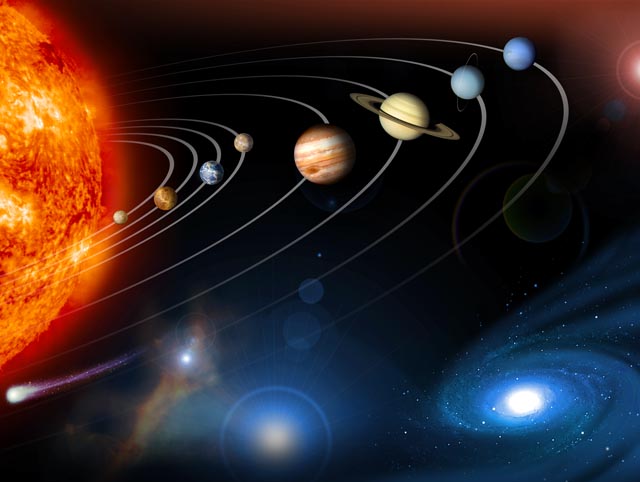
Our Solar System consists of the Sun and the 186+ celestial
objects bound to it by gravity: eight planets and five dwarf
planets, their 173 known moons and billions of small objects.
For more details, click image.
1 Earth Day = 1 rotation of the earth around its axis = 86,400 seconds = 1440 minutes = 24 hours
1 Earth Month = 1 revolution of moon around the earth, comes from word "moonth" = 30.4368499 days
1 Earth Year = 1 revolution of the earth around the sun, Julian year = 365.25 days = 12 months
The Sun "Ground zero", Radius ≈ 109 x earth, Mass ≈ 332,800 x earth
Mercury ≈ 36 million miles from sun, Radius ≈ .38 x earth, Mass ≈ .05 x earth, Orbit ≈ 88 earth days
Venus ≈ 67 million miles from sun, Radius ≈ .95 x earth, Mass ≈ .89 x earth, Orbit ≈ 225 earth days
Earth ≈ 93 million miles from sun, Radius ≈ 1 x earth, Mass ≈ 1 x earth, Orbit ≈ 365 earth days
Mars ≈ 142 million miles from sun, Radius ≈ .53 x earth, Mass ≈ .11 x earth, Orbit ≈ 687 earth days
Jupiter ≈ 484 million miles from sun, Radius ≈ 11 x earth, Mass ≈ 318 x earth, Orbit ≈ 11.9 earth years
Saturn ≈ 888 million miles from sun, Radius ≈ 9 x earth, Mass ≈ 95 x earth, Orbit ≈ 29 earth years
Uranus ≈ 1.8 billion miles from sun, Radius ≈ 4 x earth, Mass ≈ 17 x earth, Orbit ≈ 84 earth years
Neptune ≈ 2.8 billion miles from sun, Radius ≈ 4 x earth, Mass ≈ 17 x earth, Orbit ≈ 165 earth years
Pluto ≈ 3.7 billion miles from sun, Radius ≈ .18 x earth, Mass ≈ .002 x earth, Orbit ≈ 248 earth years
Dwarf Planet Body orbiting the Sun massive enough to be rounded by its own gravity, but not quite a planet.
Comets Small, celestial bodies that orbit around the sun; they are made up of ice, gas and dust.
Meteors Known as "shooting stars", meteors are actually fallen debris from a comet.
Asteroids Metallic, rocky bodies without atmospheres that orbit the Sun; too small to be classified as planets.
Asteroid Belt Region located between the orbits of the planets Mars and Jupiter; occupied by many asteroids.
Kuiper Belt Region beyond the planets extending from Neptune's orbit; objects composed of frozen "ices".
Oort Cloud Defines the gravitational boundary of our Solar System; spherical cloud of comets.
_______________________________________________________________________________________________
Stars
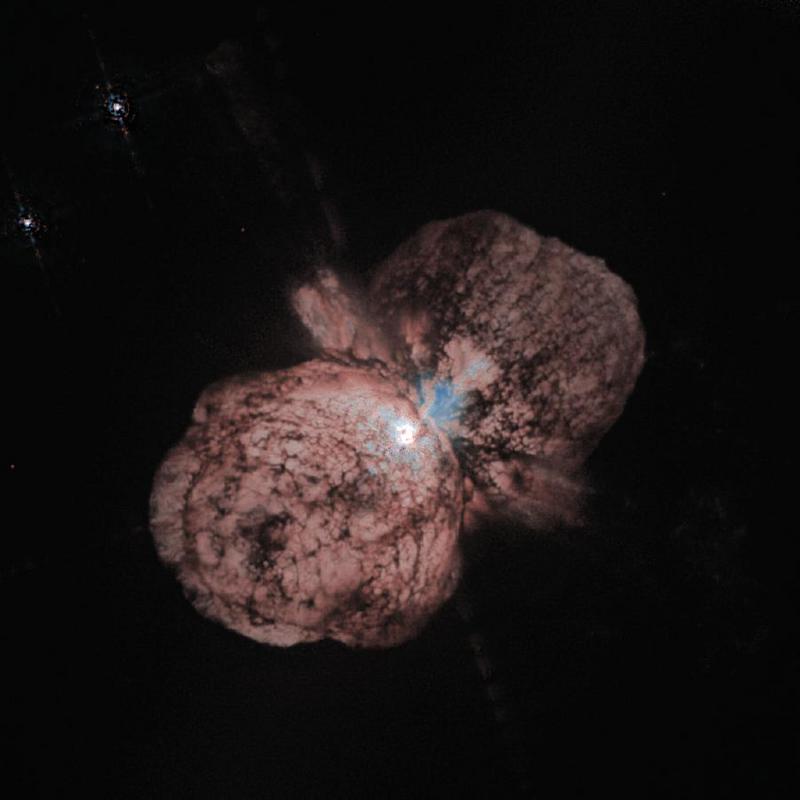
-- Eta Carinae, one of biggest stars in Milky Way galaxy --
7500 light years from our solar system, 10 billion miles diameter,
size of our solar system, 100 times more massive than our sun
and radiates 4 million times the energy of our sun!
What is a star?
Defined
What is a Nebula? - Interstellar cloud of dust, hydrogen gas and plasma; where stars are born (stellar nursery).
Nebula Gallery
Birth of a Star
Life Cycle of a Star
Death of a Star
Supernova - Death explosion of a massive star; causes sharp increase in brightness, then a gradual fading.
Supernovae
Globular Clusters - Gravitationally bound concentrations of ≈ ten thousand to one million stars, tightly bound.
Open Clusters - Group of few thousand stars that were formed from the same molecular cloud, loosely bound.
Constellations - Imaginary objects used to reference stars; farmers, astronomers created over past 6,000 years.
More Constellations
Catalog of stars
_______________________________________________________________________________________________
Galaxies
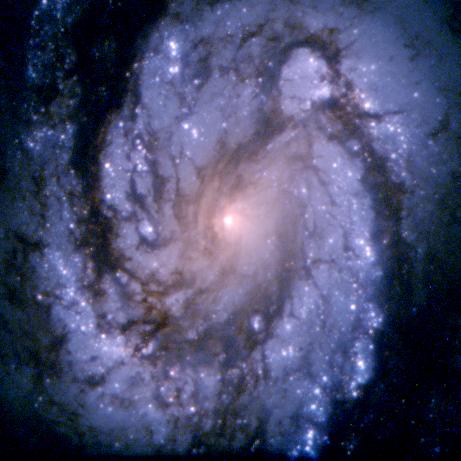
-- The M100 spiral galaxy is located in the Virgo cluster --
It's 50+ million light years away and is also cataloged NGC4321.
The total number of galaxies in our universe varies widely, but we generally know there are between 100 billion
and 500 billion galaxies in our visible universe! Many of these galaxies each have 100+ billion stars! There are
some galaxies with trillions of stars! Ask an Astrophysicist, Physics.org, Cornell University
Galaxy Defined (Many versions of definition)
Our Milky Way
Three types of classified galaxies:
1) Spiral - most common type of galaxy; looks like spirals with long arms winding toward a bright bulge at center.
2) Elliptical - range of sizes; takes the form of ellipsoid, with no spiral structure or flattened disks; 15% of galaxies.
3) Irregular - has little symmetry in the structure; often chaotic in appearance; contains large amounts of gas/dust.
Largest Galaxies?
Abell 2029 (≈ 6 Million light years diameter, 1 Billion light years away)
Farthest Galaxies?
Hubble Ultra Deep Field (10,000 galaxies that are ≈ 13 Billion light years away!)
Hubble Deep Field South
Galaxy Clusters
_______________________________________________________________________________________________
Black Holes
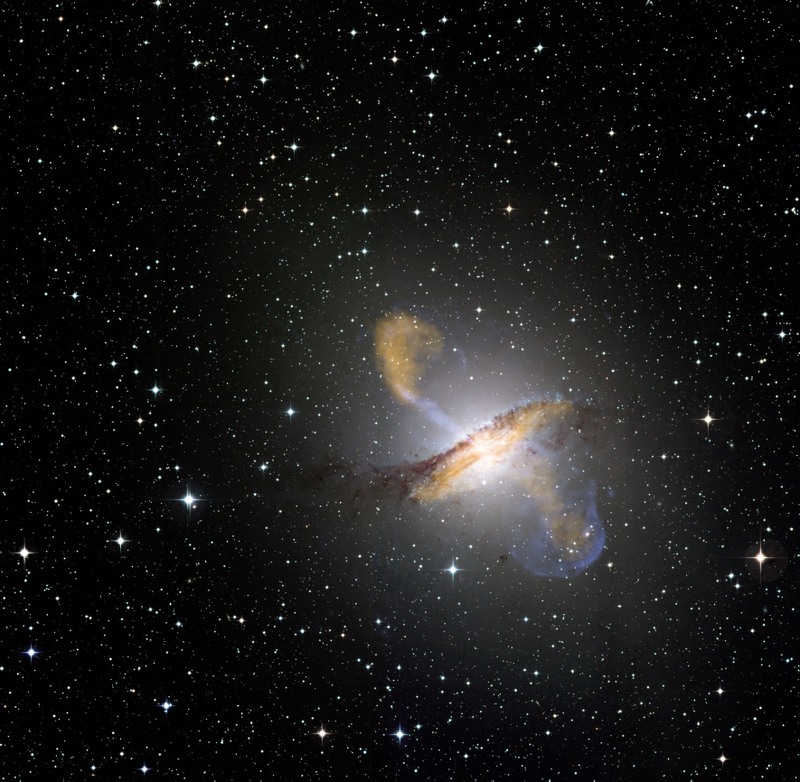
-- Centaurus A, nearest giant galaxy, 10-13 million light years away --
It has a black hole with a billion times the mass of the Sun! Click image.
Black holes are the cold remnants of former stars, so dense that no matter—not even light—
is able to escape their powerful gravitational pull! Mighty Void (opening ad?)
Event Horizon - the gravity field of a black hole where the space-time is so bent that light cannot escape it.
Singularity - term often used to refer to the center of a black hole, where the gravitational field becomes infinite.
Black Holes?
Black Hole details
How Black Holes Work
Black Hole Facts
More Facts
Ask an Astonomer
Black Hole Stories
Black Holes Animated
FAQ
More FAQ
Binary Black Hole System?
_______________________________________________________________________________________________
Misc
PulsarsQuasars
Dark Matter
Got a question? (Ask an Astrophysicist..... who? )
_______________________________________________________________________________________________
Tools/Resources
Zoom Astronomy (Enchanted Learning for all ages)JavaLab (Cool Java applets built by Case Western Reserve University's Department of Astronomy; need JRE plug-in installed)
Universal Atlas
Stephen Hawking's Universe
His Website
MS WorldWide Telescope (WWT)
Install WWT
WWT Article (opening ad?)
Google Sky - Either navigate the universe manually just to see what's out there or use Google's internal search
to look for particular objects. Example: From the web page, do a search for Crab Nebula and it will render Hubble's
view of that nebula. Check out our nearest galaxy, Andromeda too. You can search for most celestial objects that
we know about and you can zoom in/out by using the zoom bar on the side (or double clicking image). Navigate by
dragging the image to the left or right with your mouse. Also a showcase at bottom with customized views...
_______________________________________________________________________________________________
Famous Astronomers/Physicists
Galileo Galilei (1564 - 1642)Isaac Newton (1643 - 1727)
Albert Einstein (1879 - 1955)
Stephen Hawking (1942 - ?)
It is estimated that there may be over 10 BILLION TRILLION stars in our visible universe!!!
2003 Star Survey Ask an Astrophysicist Theories Stars or grains of sand? Will we ever really know?